
Why Boutique Production Agencies are Outpacing Large Houses in 2026
In 2026, agility is everything. See why boutique agencies are beating large production houses through senior-led strategy and rapid AI integration.

For decades, the standard playbook for major brand campaigns was simple: if you wanted scale, you went big. You signed a retainer with a holding company’s massive production arm, accepted the overhead, and trusted that the sheer number of bodies on the account would guarantee success.
But by 2026, the playbook has been completely rewritten.
The content landscape today is fragmented, hyper-fast, and demands authenticity above all else. In this environment, the "factory mentality" of massive production houses—burdened by layers of bureaucracy, slow adoption of Agentic AI, and disconnected client relationships—is no longer a competitive advantage. It’s a liability.
Boutique production agencies are no longer just "scrappy alternatives"; they are the preferred strategic partners for brands that need to move at the speed of culture.
Here is why smaller, specialized production agencies are outpacing the giants in 2026.
1. The Agility Advantage: Moving at Speed, Not Process
In 2026, marketing opportunities appear and vanish in days. A trend on a new spatial computing platform or a viral moment requires an immediate, high-quality production response.

Large production houses are built for stability, not speed. A creative change might require approvals from an account manager, a creative director, a producer, and potentially a VP before a camera even turns on.
The Boutique Difference: Boutique agencies have flattened the hierarchy. When you work with a smaller team, you are usually talking directly to the decision-makers and the creators. Changes are made in real-time, not through a ticketing system. This allows boutiques to compress production timelines from weeks to days without sacrificing craft.
2. Direct Access to Senior Talent
When you sign with a massive production house, the "pitch team" is rarely the "execution team." Senior partners handle the sale, but your day-to-day project is often passed down to junior producers or associates. You are paying enterprise rates for entry-level execution.
The Boutique Difference: In a boutique agency, senior talent is "baked into" the process. Because they handle a limited number of clients, the owners, highly skilled directors, and lead editors are often directly involved in your project. You aren’t one of a thousand accounts; you are a vital partner, and you receive the corresponding level of expertise.
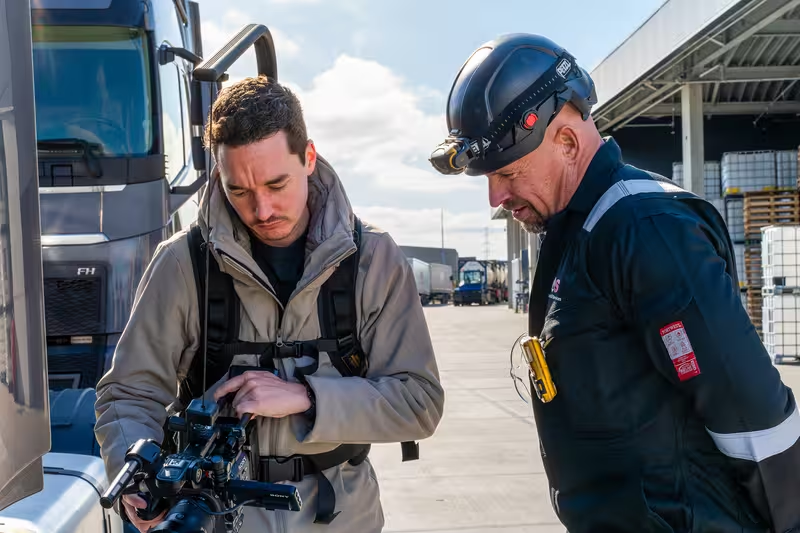
3. The Shift from Execution to Strategic Partnership
This is the most critical shift in 2026. Large production houses are generally designed to consume a brief and execute against it. They are vendors. They deliver assets.
But by 2026, brands don't just need assets; they need answers. They need partners who understand why they are making a piece of content and where it fits in their ecosystem.
The Boutique Difference: Smaller agencies function as an extension of the client's internal marketing team. They have the time and desire to deeply understand your business goals, your brand voice, and your audience. Because they aren't managing massive overhead, they can focus on solving strategic problems at the speed of execution.
4. Efficient Costs and Technology Adoption
A significant portion of a large house’s fee funds their real estate, their legacy pension funds, and the multiple layers of management that don't actually touch your project.
Furthermore, these massive machines are often the slowest to adapt. By 2026, Agentic AI—AI that can autonomously handle tasks like asset resizing, color grading basic footage, or generating initial storyboards—has revolutionized production efficiency. Large agencies, protecting legacy billing models, have been slow to integrate these tools.
The Boutique Difference: Boutiques are, by necessity, efficient. Every dollar you spend goes toward the talent and the technology that directly benefits your project. Moreover, smaller agencies were the first to master Agentic AI, using it to cut manual labor costs and compress schedules, allowing them to offer enterprise-level quality on boutique budgets.
By The Numbers: The Industry Shift
The market data confirms what brands are feeling. The production landscape in 2026 is defined by consolidation among giants and a explosion of growth among independent specialists.
- The CMO Pivot: A majority of CMOs in 2026 are actively consolidating their agency rosters, moving away from large retainers toward "best-in-class" specialized partners.
- The AI Efficiency Gap: In industry sentiment surveys from 2026, nearly 95% of professionals identify AI as a primary driver of operational change. Smaller, specialized firms reported integrating these tools at twice the rate of holding company production houses.
- Talent Migration: The "Great Resignation" of years past evolved into a "Great Founder Boom." Senior creatives and producers from holding companies have launched their own boutiques, taking their enterprise skill sets with them.
Conclusion
Working with a giant production house in 2026 is still useful if you need to mobilize a 1,000-person crew in 50 countries simultaneously.
But for the day-to-day reality of modern marketing—where you need speed, senior expertise, advanced technological proficiency, and a true strategic partner to navigate a complex landscape—boutique agencies are no longer just a viable option. They are the winning choice.
The future of production isn't big. It's nimble.

Subscribe to our newsletter
Get production tips, creative insights, and behind-the-scenes stories delivered straight to your inbox. No fluff — just useful stuff.