What actually makes a video "cinematic"?
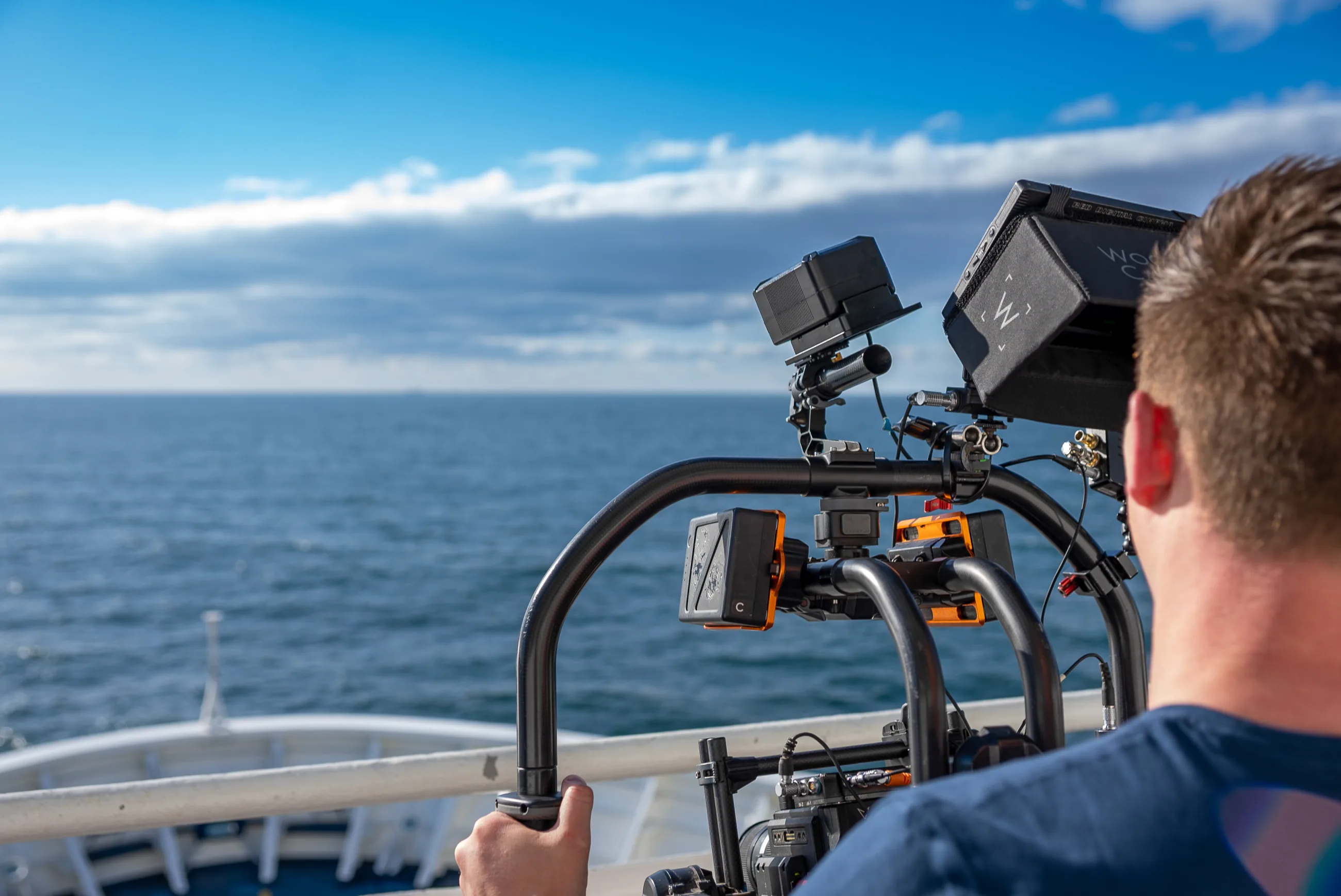
"Cinematic" is the most requested and least defined word in a video brief. It usually arrives meaning "better", which is not something anyone can shoot. It does have a real meaning, though, and it has almost nothing to do with budget — which is why so many expensive films are not cinematic and some very lean ones are.
Key takeaways
- Cinematic is a language, not a price. It is a set of conventions borrowed from narrative film, and they can be used at any budget.
- Intent is the whole test. A move, a cut or a lens choice is cinematic when it means something and decorative when it does not.
- Staging does more than the camera. Where people are placed and how they move through a space carries most of the effect.
- Patience reads as confidence. Fast cutting usually signals thin material, not energy.
- Most "cinematic" requests are actually requests for restraint — fewer elements, held longer, with less explanation.

What makes a video cinematic?
A video is cinematic when it uses the visual grammar of narrative film: subjects staged in depth rather than presented to camera, movement motivated by action rather than added for interest, shots held long enough to be read, and sound designed to build a world rather than to fill silence. It is a set of storytelling conventions, not a level of spend.
Cinematic is not the same as expensive
Worth settling first, because the two words get used interchangeably and they lead to opposite decisions.
| Expensive | Cinematic | |
|---|---|---|
| What it is | Resource | Language |
| Bought with | Days, crew, cast, art department | Decisions about staging, lens, timing and sound |
| Fails when | Money goes to invisible lines | Technique is applied without intent |
| Typical symptom of failure | A costly film that feels flat | A beautiful film that feels empty |
The two support each other — control over light and time makes cinematic choices easier to execute — but they are separate problems. Where the money goes is covered in what makes a video look expensive. This piece is about the other half.
Why does staging matter more than the camera?
Because cinema stages people in space, and corporate video presents people to a lens. That single difference accounts for most of the gap.
In a presented frame, the subject faces camera, centred, at a fixed distance, and delivers. In a staged frame, the subject occupies a space that continues past them — there is something between the camera and them, something behind them, and a reason for them to be where they are. The viewer reads the second as a world and the first as a message.
Three staging decisions carry most of the effect, and none of them cost anything:
- Depth. Put something in the foreground. A doorway, a shoulder, a machine, a plant. Flat frames read as broadcast; layered frames read as film.
- Off-axis eyelines. A subject speaking slightly past the lens is in a scene. A subject speaking down the lens is in an advertisement. Both are valid, and they mean different things.
- Motivated position. The subject is somewhere for a reason that the frame explains. A person at a workbench holding a component is doing something. The same person against a wall is waiting to be filmed.
When does camera movement help?
When it is motivated. A move that follows an action, reveals information, or changes the viewer's relationship to a subject is doing work. A move added because a static shot felt boring is decoration, and audiences read decoration as filler even when they cannot name it.
The most common failure in brand film is constant low-grade drift — everything gently sliding, all the time. It is meant to feel alive and it reads as nervous, because nothing in the movement corresponds to anything happening.
A workable test before any move: what does the viewer know at the end of this move that they did not know at the start? If the answer is nothing, lock the shot off. A held frame is a confident frame.
This is also where specialist camera work earns its place or does not. FPV drone, for instance, is genuinely cinematic when it does something conventional coverage cannot — a continuous move through a space that explains how that space fits together. Used as an establishing flourish, it is an expensive way to look like everyone else.
Does lens choice make a video cinematic?
Lens choice contributes, but it is the most over-credited item on the list. Shallow depth of field has become shorthand for "cinematic" and it is neither necessary nor sufficient.
What lens choice actually controls is the viewer's sense of distance and of space. Longer lenses compress and isolate, which suits observation and intimacy. Wider lenses used close put the viewer inside a space, which suits energy and involvement. Both are cinematic when the choice matches the intent. Neither is cinematic when the whole film is shot wide open because that is the look.
The tell of an inexperienced production is a film where every shot has the same lens character and the same shallow background. Real films vary the distance because the story varies.
Why does holding a shot longer feel cinematic?
Because duration signals that the material can withstand attention.
Fast cutting is frequently a post-production repair. When individual shots are not strong enough to hold, the edit moves before the viewer can register that, and the resulting energy is borrowed rather than earned. Audiences are extremely good at sensing this, which is why heavily cut corporate video feels frantic rather than exciting.
Two practical consequences for anyone commissioning:
- Shoot fewer setups and give each more time. A film with eighteen strong shots beats one with sixty adequate ones.
- Resist the urge to fill. A held frame with room tone in it does more for pace than three quick cuts, because it gives the viewer somewhere to arrive.
How does sound make a film cinematic?
By building a space the viewer believes is continuous. Cinema is relentlessly specific about sound and corporate video almost never is.
The difference is usually three things. First, atmosphere — every location has a bed of sound, and its absence makes a cut feel like a cut. Second, detail — a door, a footstep, a machine, placed deliberately, tells the viewer the world exists off-screen. Third, music that is written to the edit rather than laid over it, so that musical events and visual events land together.
That last one is the largest single lever, and it is the reason DOT composes original music in-house. It is argued in full in why custom music elevates a brand film.
Do aspect ratio and frame rate matter?
Less than the internet suggests, and not in the way people expect.
- Aspect ratio. A wider frame carries cinematic association, but letterboxing a film shot for 16:9 adds nothing except lost image. If a wider ratio is wanted, compose for it on the day.
- Frame rate. 24 or 25 frames per second reads as film because that is the convention audiences have learned. Higher rates read as broadcast or live. This is genuinely a real effect and it is also the easiest box to tick, which is why it should not be mistaken for the work.
- Slow motion. Powerful when a moment deserves extension. Corrosive when applied to everything, because it removes the contrast that made it meaningful.
Vertical formats deserve a note. Cinematic grammar was built for a horizontal frame, and most of it does not survive a crop. A vertical film that works has been staged vertically — subjects layered up the frame rather than across it. That is a different craft, not a lesser one, and it is covered on the social and short-form page.
Can a low-budget video be cinematic?
Yes, and this is the practically useful part of the answer. Every element above is a decision rather than a purchase.
A single-location film, one camera, small crew, can be genuinely cinematic if the subject is staged in depth, the frames are held, the lens choices vary with intent, and the sound is designed rather than assumed. That film may sit near the lower end of a production range and still be the strongest thing a brand has.
What a low budget genuinely restricts is scale and control — how many places you can go, how much of a room you can light, how many people can be in front of the camera. Those things affect whether a film looks expensive. They do not determine whether it is cinematic.
How should you brief "cinematic"?
Not with the word. It transmits nothing. Replace it with the thing you actually mean, which is usually one of five:
| If you mean | Say |
|---|---|
| It should feel unhurried | "Fewer shots, held longer. I want it to breathe." |
| It should feel observed, not presented | "Nobody talks to camera. We watch things happen." |
| It should feel emotional | "The music and the edit carry it. Less voiceover." |
| It should feel premium | That is a production value question, not a cinematic one |
| It should look like a specific film | Send the reference. It is worth more than a page of adjectives |
References are the single most efficient thing a client can supply. Three links and one sentence explaining what you like about each will shape a production more than any amount of descriptive language.
How does DOT approach this?
DOT Video Agency works from concept through to final grade in-house, including original composition and colour in a dedicated grading suite. The practical benefit is that staging, sound and edit decisions are made by the same people rather than handed between suppliers, which is where cinematic intent usually gets lost.
The working position is that restraint is almost always the right answer. Fewer setups, held longer, staged properly, with sound doing more than it is normally allowed to. It is less impressive to describe in a treatment and it is what still holds up on a third viewing.

Related reading
- What makes a video look expensive?
- Rhythm and aesthetic authority in digital commercials — the same craft argument applied specifically to skippable formats
- Why custom music elevates a brand film
- Brand film vs corporate video
- Brand film production
Have a reference you want to talk through?
Send the films you like. Twenty minutes on what is actually happening in them is the fastest route to a brief that produces the thing you had in your head.
Book a 20-minute callOr email info@madebydot.com
Last updated: