What makes a video look expensive?

Two films shot on the same camera, in the same city, in the same week can look a decade apart in quality. The difference is almost never the camera. It is a short list of decisions, most of them made before anyone turns anything on, and a few of them cost far less than people assume.
Key takeaways
- Light is the single largest variable. More of a production budget goes to controlling light than to any other line, and it is the first thing an audience reads without knowing they are reading it.
- Casting is the cheapest expensive decision. The right face costs a fraction of an extra shoot day and changes more.
- Time is the real product. Two days on one location almost always looks better than one day across three.
- Sound carries roughly half the perceived quality and typically receives under ten per cent of the budget.
- Expensive and cinematic are different things. A film can be costly and flat, or lean and cinematic. Related, not the same.
What makes a video look expensive?
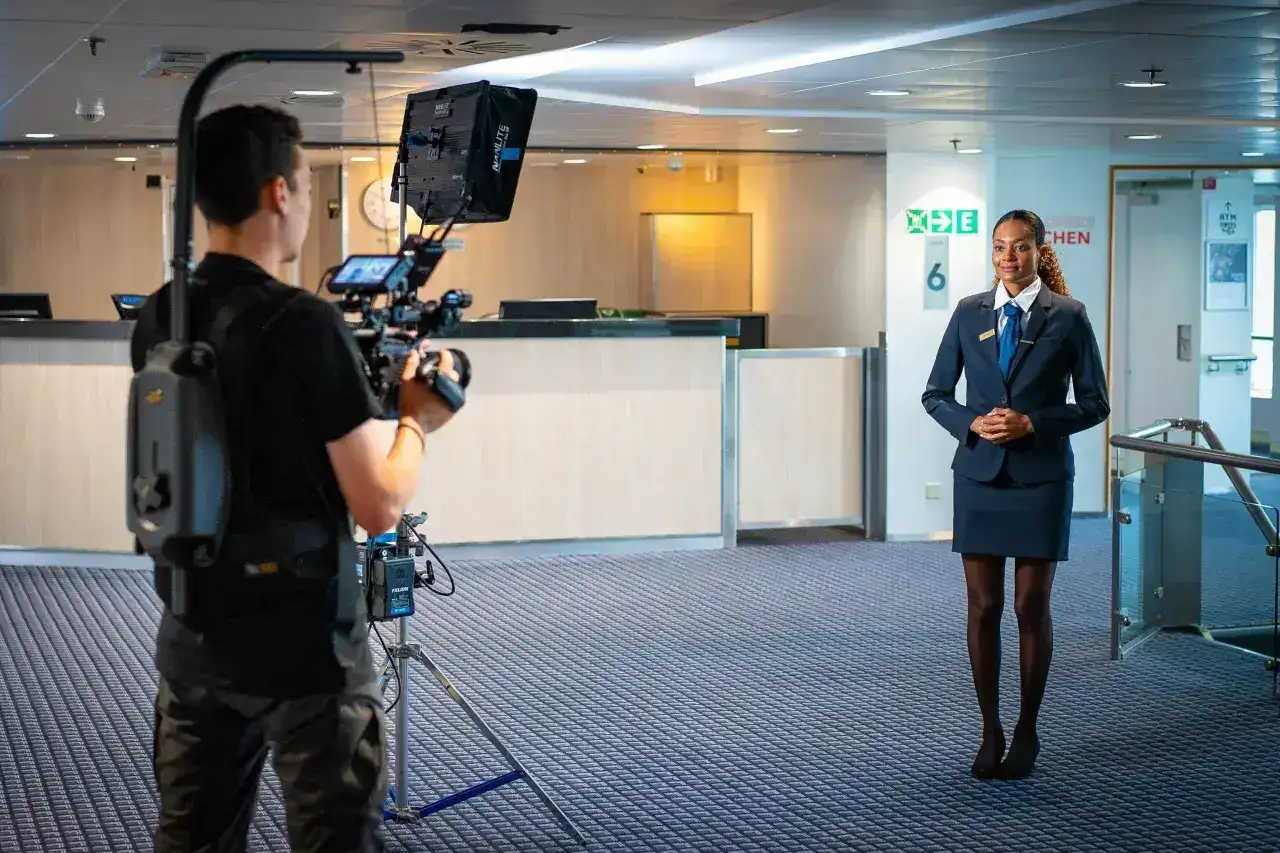
A video looks expensive when light is controlled rather than accepted, when casting and art direction are specific rather than generic, when the camera moves with intent rather than habit, and when sound is designed rather than recorded. Production value is the visible result of decisions made before the shoot, not of the equipment used during it.
Where does the money actually go?
Clients often assume the camera package is the expensive part. On most productions it is one of the smaller lines. Here is roughly how a mid-range brand film budget distributes, and what each line buys you on screen.
| Line | What it buys | Visible to the viewer? |
|---|---|---|
| Crew and time | Enough people to light properly and enough hours to shoot it twice | Enormously, and indirectly |
| Lighting and grip | Control over shape, contrast and separation | The most visible line on the sheet |
| Casting and talent | Faces that carry the idea without explaining it | Immediately, in the first two seconds |
| Art department | What is in frame besides the subject | Constantly, mostly unconsciously |
| Location | Space, ceiling height, control, permission | Yes, and it caps everything above it |
| Post and grade | Consistency, tone, finish | Yes, but it cannot invent what was not shot |
| Sound and music | Roughly half the felt quality | Almost never consciously. Always emotionally |
| Camera package | Resolution, latitude, lens character | Far less than anyone expects |
The pattern worth noticing: the lines with the largest effect on perceived quality are the ones a client cannot see on a call sheet. Nobody asks how many lighting units are going on a job. Everybody asks what camera.
Why is lighting the biggest variable?
Because it is the difference between a room being recorded and a room being designed. Available light is flat, even and directionless. It renders a face as information. Controlled light gives a face shape, separates a subject from what is behind it, and tells the eye where to go.
Three specific things read as expensive, and all three are lighting decisions:
- Separation. The subject is distinct from the background rather than sitting flat against it. Usually a light behind or above, doing nothing except creating an edge.
- Contrast that is chosen. Shadow is a decision. Footage where nothing is dark reads as an office recording, because offices are lit to eliminate shadow.
- Consistency across a day. A film shot from morning to evening will drift badly unless someone is actively fighting it. That fight costs crew hours, and its absence is the most common reason corporate video looks cheap.
This is why a lean crew is a false economy on anything meant to last. Two people can operate a camera. It takes more than two to control a room.
Why does casting matter more than budget?
Because the audience decides whether they believe a film in about two seconds, and they decide it by looking at a face. No amount of finish recovers a wrong one.
The instinct in corporate and employer-branding work is to cast for confidence — the person who presents well, who is comfortable, who volunteers. That instinct is usually wrong. Comfort on camera reads as performance, and performance reads as advertising, and advertising is what the viewer is defending against.
On a legal-sector film we made with Ploum, the most compelling person in the finished piece was an associate who had actively not wanted to take part. Reserved, precise, visibly uninterested in charming anyone. That specificity is what made the film credible, and it cost nothing except being willing to cast against the obvious choice.
Casting is the highest return per euro available in production. A considered casting process costs a fraction of an additional shoot day and changes substantially more.
What does art direction actually control?
Everything in frame that is not the subject — and therefore everything the viewer uses to judge the subject.
Cheap-looking footage is very often well-shot footage of an un-designed space. A good frame has depth, a limited palette, and nothing in it by accident. The most common failures are mundane and entirely fixable:
- Clutter behind the subject. Cables, signage, a fire extinguisher, someone's mug.
- No depth. Subject flat against a wall, nothing between camera and background.
- Colour chaos. Six competing colours in one frame, none of them the brand's.
- Wardrobe nobody discussed. Fine patterns, logos, or four people in four different registers of formality.
None of that requires a build or a set. It requires somebody whose job it is to look at the frame and remove things, and thirty minutes before the first take.
Why does a shooting schedule show up on screen?
Because rushed footage looks rushed, and it does so in ways that are hard to name and easy to feel.
When a schedule is tight, the compromises land in a predictable order. Lighting gets simplified first. Then coverage narrows, so the edit has fewer options. Then performances get accepted on the second take rather than the sixth. Then the last location of the day gets a fraction of the care the first one got, which is why so many films visibly deteriorate in the final third.
The practical rule: two days on one location will almost always look better than one day across three. Travel eats hours, every move resets the lighting, and nothing gets the attention it needed. If budget is fixed and a choice has to be made, reduce locations before reducing days.
How much of perceived quality is sound?
Roughly half, and it is the most reliably underfunded line in the industry. Audiences will forgive a soft image. They will not forgive audio that sounds like a room, and they will disengage without ever identifying why.
Three sound decisions carry most of the effect:
- Clean location dialogue. Proper microphone placement and a crew that will stop a take for an air-conditioning unit.
- Designed atmosphere. Rooms have sound. A film with no ambient bed feels synthetic even when the picture is excellent.
- Music written for the cut. A licensed track sits alongside a film. A score written to the edit hits with it, and that difference is felt as production value even by viewers who could not explain it.
DOT composes original music in-house — more than 150 custom tracks since 2018 — which is partly a creative position and partly a practical one. It is covered properly in why custom music elevates a brand film.
What looks expensive but costs very little?
Not everything on this list needs budget. Several of the strongest signals are free, and they are free because they are decisions rather than purchases.
| Decision | Cost | Effect |
|---|---|---|
| Cut the script by a third | None | Pace, confidence, fewer weak lines to perform |
| Fewer, better locations | Negative | More time per setup, better light |
| Wardrobe direction in advance | One email | Removes the most common frame-level problem |
| Cast for credibility, not comfort | None | The largest single credibility gain available |
| Clear the background | Thirty minutes | Immediate lift on every frame |
| Hold the shot longer | None | Confidence. Fast cutting often hides thin material |
What does not make a video look more expensive?
Worth naming, because these are where budget most often goes to die.
- A higher-end camera body. Beyond a professional baseline, the returns are marginal and invisible to a viewer.
- More resolution. Useful for reframing in post. Irrelevant to how a film feels.
- Drone shots by default. An aerial that does not serve the idea reads as a stock opener, and an audience has seen thousands.
- More coverage of the same thing. Five angles on a weak moment is still a weak moment.
- Heavy grading. A strong grade finishes good footage. On flat footage it announces itself.
What does high production value cost?
DOT projects run from €2.500 to €50.000, with most landing between €8.500 and €15.000. The variable driving that spread is almost never equipment. It is days, locations, crew size, cast and the complexity of post.
Two useful reference points. A single-location film with a small cast, one shooting day and a proper crew sits near the lower half of that range and can look genuinely premium. A multi-location, multi-market campaign with professional talent and a full art department sits at the top, and most of the increase is time and people rather than kit.
Full bands per service are published on the services page.
Is "expensive" the same as "cinematic"?
No, and conflating them is how budget gets misspent. Expensive is about resource. Cinematic is about language.
A film can carry every marker of expenditure — large crew, professional talent, considerable spend — and still feel like a corporate video, because nothing in how it is staged, blocked or cut is doing any work. Equally, a film made for a fraction of that can feel cinematic, because someone made deliberate choices about lens, movement, pacing and restraint.
The two overlap and they are not the same question. If what you actually want is the second one, that is covered in what actually makes a video cinematic.
How does DOT approach production value?
DOT Video Agency works from concept through to final grade in-house, including original music and colour. Founders Tijmen van Grieken and Jesper de Rek are on set rather than above it, which means the decisions that determine production value are made by the people who sold the idea.
In practice, that shows up as a bias toward fewer locations and more time, casting for credibility over polish, and protecting the sound budget when something has to give. Those are unglamorous positions. They are also the ones that decide whether a film still holds up in three years.
Related reading
Working out what your budget actually buys?
The useful version of this conversation happens before a quote, not after one. Twenty minutes is normally enough to establish what is achievable at the number you have.
Book a 20-minute callOr email info@madebydot.com
Last updated: