What separates B2B video marketing that works from video that just looks good
In 2019, a marketing director showed us a video her team had spent forty thousand euros on. Beautiful footage. Drone shots of the headquarters, slow-motion handshakes, a voiceover about innovation and partnership. She asked us why it had done nothing. No leads, no shares, barely any views past the first week.
We watched it twice. The problem wasn't the production. The production was excellent. The problem was that the film could have belonged to any company in her sector. Swap the logo and nothing would change. It said everything a serious business is supposed to say and, for exactly that reason, it said nothing at all.
That conversation has stuck with us for years, because it captures the single most expensive mistake in B2B video marketing. Companies invest in how the video looks before they've decided what the video believes. And an audience can tell the difference in the first five seconds.
What makes B2B video marketing actually work?
B2B video marketing works when it's built on a specific point of view, not a product description. Videos anchored to a belief the company genuinely holds outperform polished product overviews because audiences remember ideas, not features. The production quality gets you watched. The idea gets you remembered.
Here's the shift we've watched play out across seven years of making films for B2B brands. For a long time, the industry equated professionalism with polish. Higher resolution, smoother edits, more expensive kit. Polish became the proxy for quality, and the brief for most corporate video was, in effect, "make us look serious."
But polish is now the baseline, not the differentiator. Everyone has access to it. The camera on a mid-range phone shoots in 4K. Editing software that cost thousands is now a monthly subscription. When everyone can look good, looking good stops setting you apart. What sets you apart is having something to say that your competitor couldn't say in the same words.
Why do most corporate videos fail to get results?
Most corporate videos fail because they describe what a company does instead of arguing for what it believes. Product-led videos are interchangeable: any competitor could make the same claims. Without a distinct point of view, the video becomes forgettable regardless of budget, and a forgettable video generates no leads, shares, or recall.
This is the corporate storytelling trap. A company sits down to make a video and starts from the wrong question. It asks "what do we want to say about ourselves?" when it should ask "what do we believe about our customer's world that our competitors don't?"
The first question produces a list of features and values. Reliable. Innovative. Customer-focused. Every company claims these, which means none of them land. The second question produces a genuine point of view, and a point of view is the only thing an audience can't get from your competitor.
We learned this the hard way on our own early work, too. Some of the first films we made were technically clean and strategically empty. We were proud of how they looked and quietly puzzled when they underperformed. It took us longer than we'd like to admit to understand that the belief has to come before the camera.
What does B2B video marketing built on an idea look like?
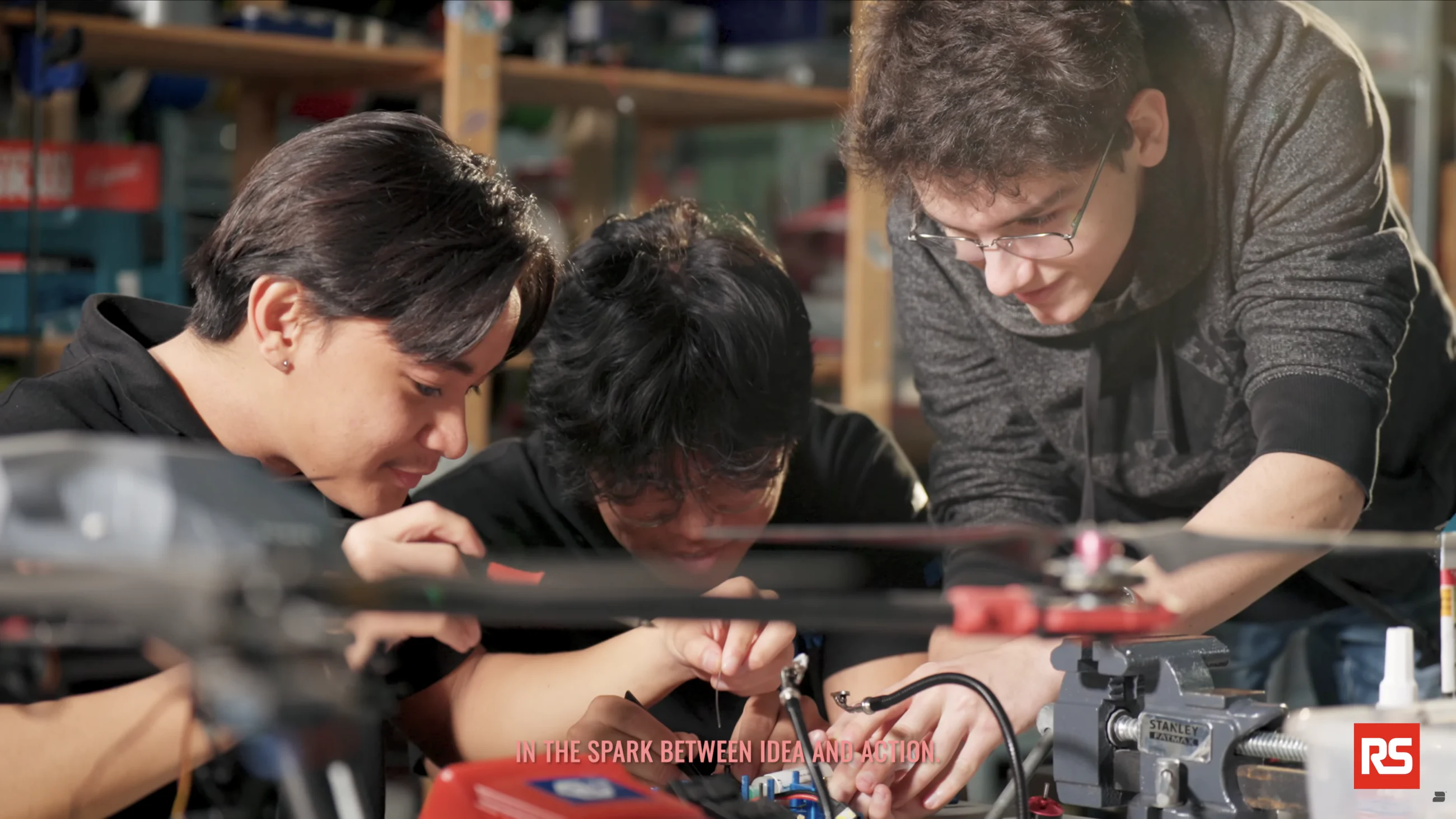
It looks like a film that starts from a conviction and lets the product appear as evidence. For RS, a global components distributor, we didn't make a video about components. We made a campaign about courage: the belief that the engineers and makers who reach for RS share a willingness to trust they'll find the solution.
That campaign, Be Bold, is worth sitting with because the temptation was enormous to do the opposite. RS distributes hundreds of thousands of products. The obvious brief was a capabilities film: the range, the logistics, the reliability. Instead we filmed VanDijk-Racing Powerboats in Belgium and Drone Team Twente in the Netherlands, the people who actually embody the courage the brand wanted to stand for. The products are in the work, but they're never the point. The point is the belief, and the belief is what an engineer remembers.
The result is a piece of B2B video content that does something a capabilities film never could. It makes an audience feel recognised. And an audience that feels recognised is an audience that comes back.
How does storytelling improve B2B video marketing performance?
Storytelling improves performance because a story gives the viewer a reason to keep watching and a reason to remember. B2B brand storytelling anchored to real people and genuine stakes outperforms feature lists because narrative creates emotional recall, and emotional recall is what drives a viewer to act or share weeks later.
Consider two of the partnerships that taught us the most. For Feadship, the yacht builder, one of the projects we're proudest of wasn't a product film at all. It was built around music: an original composition, performed live, that expressed what the brand feels like rather than what it makes. Soundwaves put the emotional truth of the brand on screen, and it worked because it trusted the audience to feel something rather than be told something.
For Rompslomp, the Dutch accounting software company, the insight came from their own marketing team: freelancers distrust marketing, so the content had to be genuinely useful rather than promotional. The films we built with them feature real freelancers telling real stories about the messy reality of working for themselves. No product pitch. The software appears only because it's part of how these people actually run their lives. That restraint is the strategy, and it's why the content earns trust that a polished promotional film never could.
Three different brands, three different beliefs, one shared principle. The idea came first. The film was built to carry it.
What should companies prioritise in a B2B video strategy?
Companies should prioritise a clear point of view before production value. A strong B2B video strategy starts by defining what the brand believes about its customer's world, then uses craft to express that belief. Budget spent on polish without a distinct idea produces forgettable video; budget spent expressing a real conviction compounds in recall and results.
The practical test is simple. Before a single frame is shot, ask whether your competitor could make the same video by swapping their logo for yours. If the answer is yes, you don't have a video strategy yet. You have a production plan. The strategy is the part that comes before: the argument only your company can make, made in a way only your company would make it.
Where B2B video marketing is heading
There's a reason this matters more now than it did when that marketing director showed us her forty-thousand-euro film in 2019. AI-generated video is arriving fast, and it is going to make technical quality effectively free. Anyone will be able to produce something that looks professional. Polish, already the baseline, is about to become the floor.
When technical quality costs nothing, the only thing left that's scarce is original thinking. A genuine point of view. A belief the company actually holds, expressed in a way a machine couldn't generate because a machine doesn't have convictions. The brands that win the next decade of B2B video marketing won't be the ones with the best cameras. They'll be the ones with something true to say.
That's the whole argument, and it hasn't changed since 2019. The video that works isn't the one that looks the most expensive. It's the one that could only have come from you.
See how this thinking translates into work, or tell us what your brand actually believes and we'll help you build the film that carries it.
Get in touchLast updated: